Investment conditions

How we’re thinking about markets…
Oil is back near $100 a barrel, inflation has stopped falling, and three of the world’s four major central banks raised interest rates within nine days in September. Equity markets have absorbed all of that remarkably well, because company profits are still growing strongly. The result is a market that has stopped racing ahead, but has not turned down, and a period in which we have changed where the risk sits in portfolios rather than how much of it we hold.
Three things that defined markets this AAC cycle
1. Oil rallied back to $100 per barrel
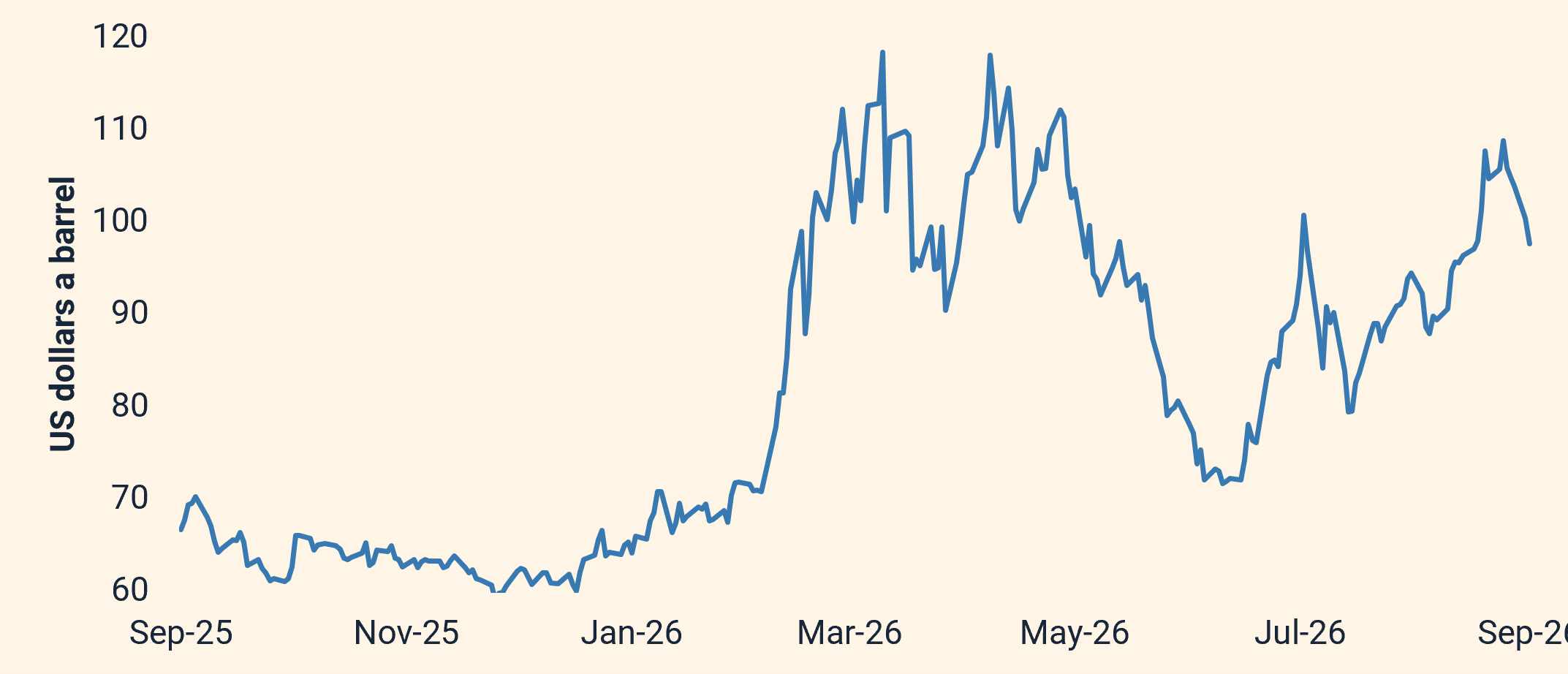
Source: Brent crude, front-month futures (CO1), US dollars a barrel, weekly Source: Bloomberg, CO1 Comdty
Brent crude climbed from around $73 at the end of June, touching a peak of $105 in mid-September. The ceasefire in the Middle East that initially helped bring prices lower has not been enough to keep them there, and a renewed escalation of tensions has pushed prices higher once again. This is important because rising energy costs have a broad impact on inflation, affecting the price of everything from transport and production to everyday consumer goods.[1]
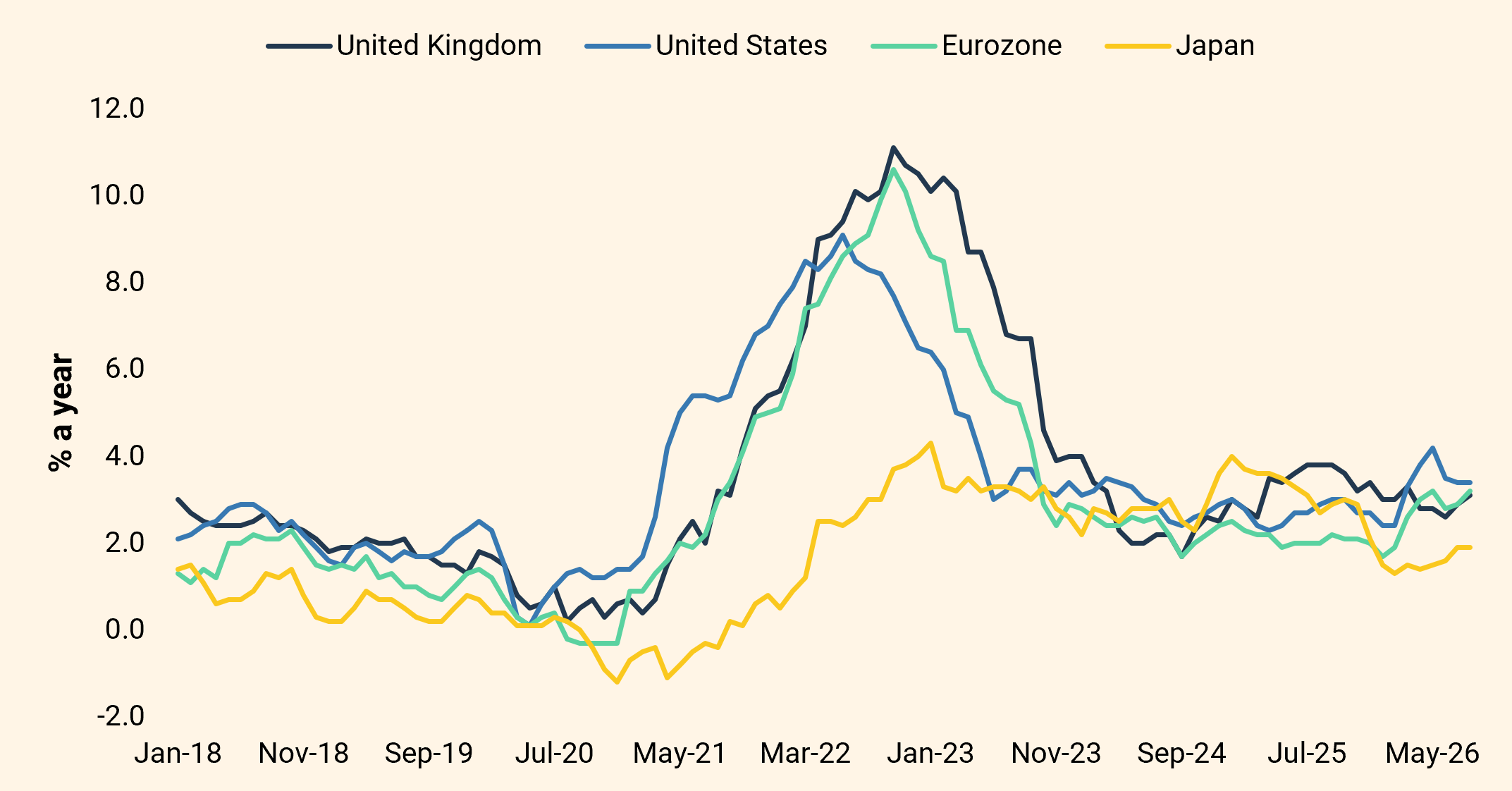
Source: Bloomberg
Inflation returned to around 2% across most major economies in late 2024, but has since begun to drift higher, with UK inflation remaining above the Bank of England’s target for more than two years. This is what economists mean by “sticky” inflation. It is not a return to the runaway price rises seen in 2022, but rather inflation proving persistently higher than the level central banks are mandated to deliver. Rising energy prices only add to this challenge, increasing costs across the economy and making it harder for inflation to return sustainably to target.
2. Three central banks raised rates in September
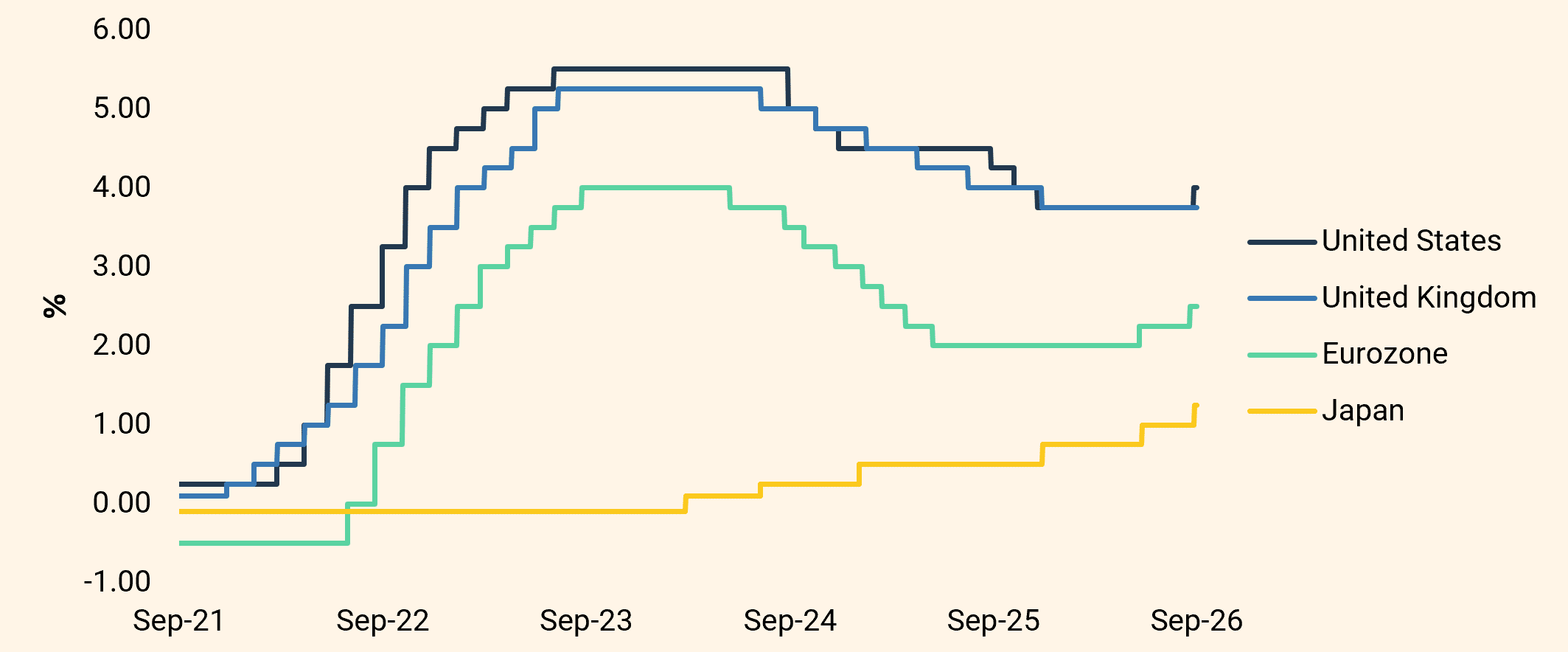
Latest: US 4.00%, UK 3.75%, Eurozone 2.50%, Japan 1.25%. US and UK overlap exactly at 3.75% from Dec 2025 until the Fed raised on 16 Sep 2026. US = upper bound of the fed funds target range. Source: Bloomberg
The direction of travel for monetary policy has switched. The European Central Bank, Federal Reserve and Bank of Japan all raised interest rates by 0.25 percentage points during September, reflecting concerns that inflationary pressures remain more persistent than expected. By contrast, the Bank of England left rates unchanged at 3.75%, maintaining a position it has held since December. The decision highlights the difficult balancing act facing policymakers. Inflation remains above target and risks being reignited by higher energy prices, yet economic growth is slowing and labour market conditions are beginning to soften.
Nine months ago, the question was how many interest rate cuts we would see this year. Today, the debate has shifted to how many further rate rises may be needed. For investors who spent much of the last decade operating in a world of falling interest rates, this is a meaningful change. The prospect of rates remaining higher for longer has important implications for economic growth, asset valuations and portfolio construction, making it one of the key considerations in our investment positioning today.
3. Equities went up anyway
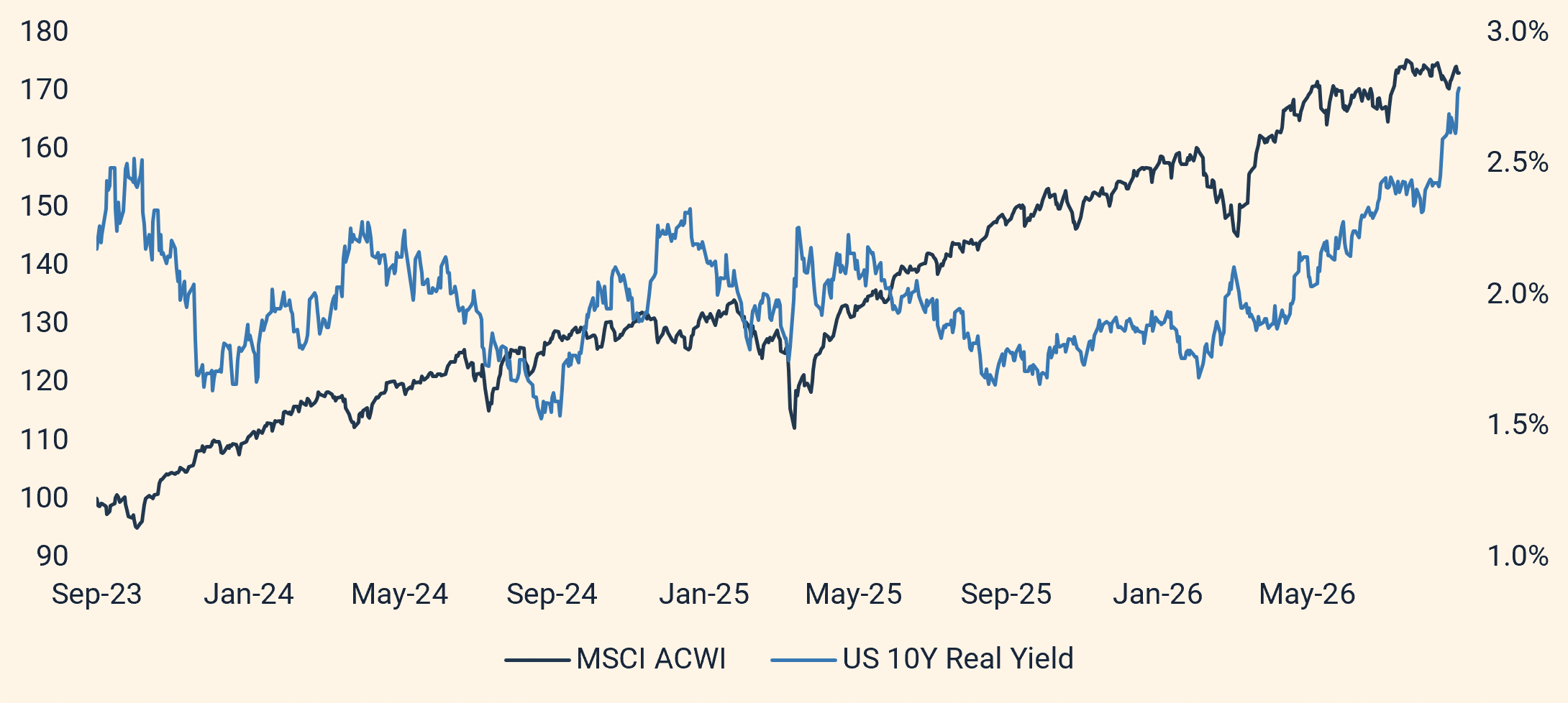
Source: MSCI All Country World Index (LHS) and 10-year yield (RHS), sourced from Bloomberg.
Normally, rising interest rates create a headwind for equity markets, as a higher cost of capital tends to weigh on economic activity and reduce the present value of future earnings. This year, however, markets have proved remarkably resilient. The primary reason has been the continued strength of corporate earnings. Analysts expect the largest US companies to grow earnings by around 18% over the next twelve months, whilst the second-quarter reporting season provided the first meaningful evidence that the substantial investment being directed towards artificial intelligence is beginning to generate tangible returns.
[1] 12-month forward earnings per share for the S&P 500, year-on-year growth rate, sourced from Bloomberg as at 22 September 2026.
That said, something did change over the summer. A sharp unwinding of some of the market’s most crowded positions in July took much of the heat out of investor sentiment, and global equities have largely traded sideways since. The three-year bull market has not necessarily come to an end, but it has moderated into a more subdued phase. Rather than being driven by ever-expanding valuations, future gains are likely to depend increasingly on companies delivering the earnings growth that investors have been anticipating.
A market that keeps getting narrower
The US equity market continues to reach new highs, but an increasingly small number of companies are driving those gains. The technology-heavy Nasdaq Index recorded a new all-time high this week, its first since June.[2] Yet beneath the surface, market performance has become increasingly concentrated. During the week in which the index reached that new peak, around a third of its constituents declined, whilst approximately half of the overall gain came from just five companies. By many measures, the current market advance is among the narrowest on record.
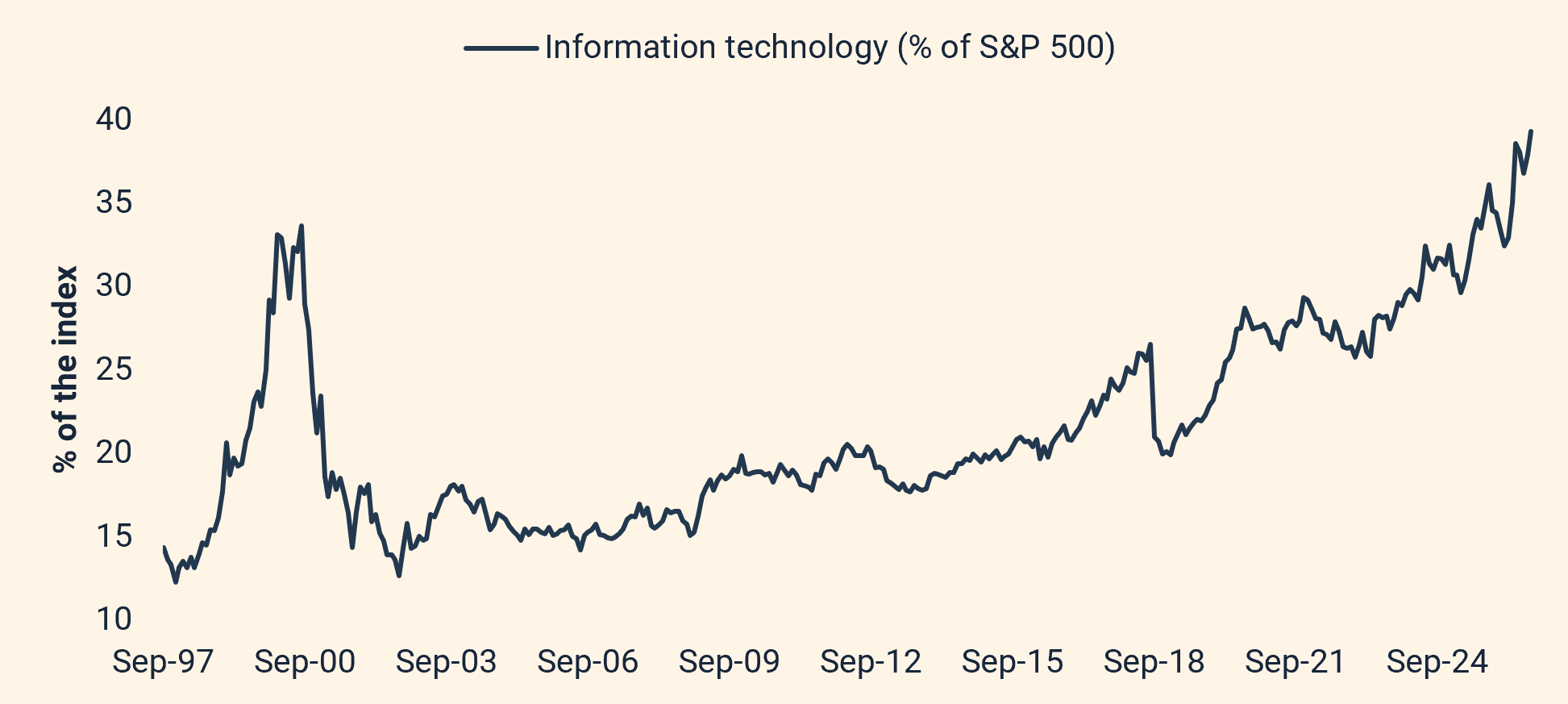
Information technology as a share of the S&P 500 by value. Quarterly, 1997 to September 2026. The sector was redefined in September 2018, when several large companies moved out of it. Source Bloomberg
The profitability of these companies is genuine and continues to grow, and there are compelling reasons why so much market value has become concentrated in a handful of businesses. However, an index dependent on a small number of companies behaves very differently from one whose returns are more broadly distributed. Investors holding a global equity tracker today therefore have significantly greater exposure to a small group of US mega-cap companies than they would have had a decade ago.
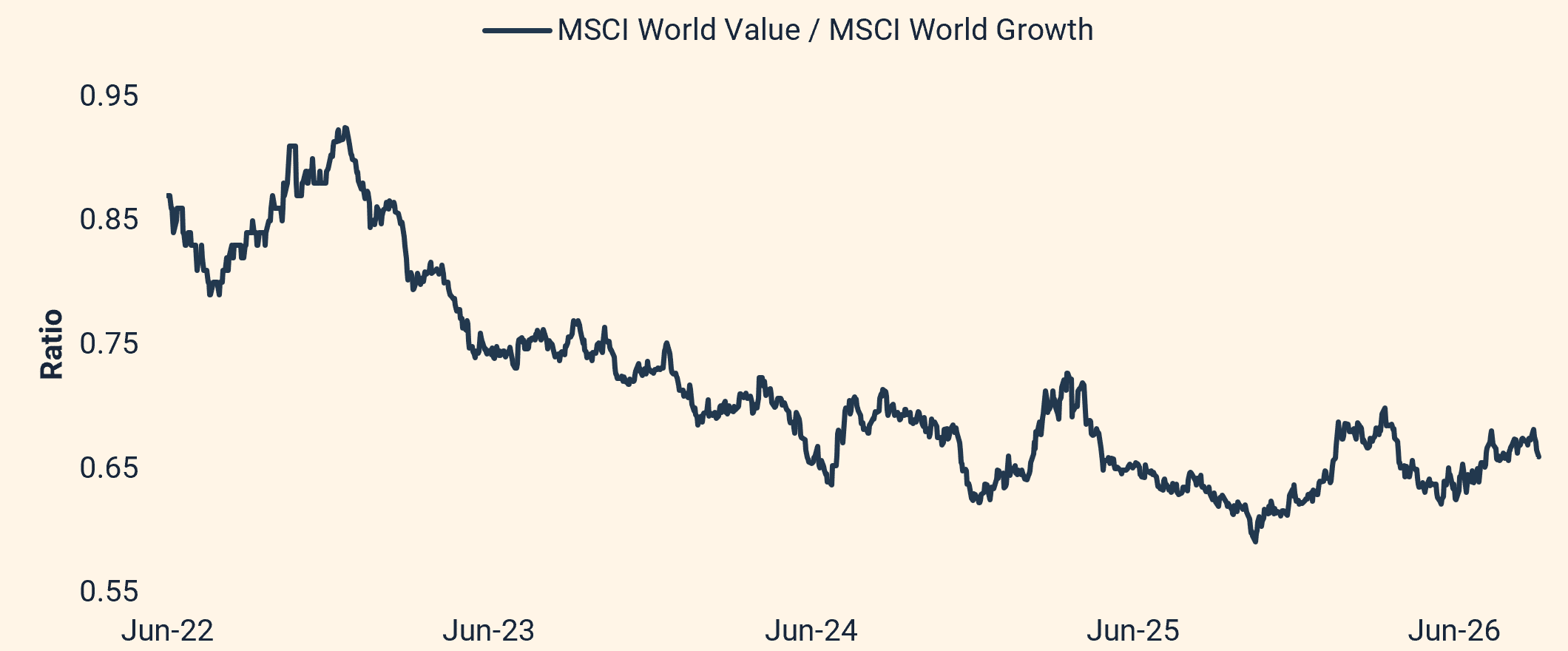
MSCI World Value divided by MSCI World Growth. A falling line means growth is outperforming, a rising line means value is. Five years to 21 September 2026.
As concentration risk within the largest US technology companies continues to increase, we remain focused on maintaining breadth and diversification within portfolios. Whilst we continue to recognise the quality and earnings power of these businesses, we are seeking opportunities in areas of the market where returns are less reliant on the continued dominance of a handful of companies. In our view, the current market structure leaves investors increasingly vulnerable should sentiment towards these firms deteriorate.
One area where we continue to see opportunity is in value equities. In late 2025, we began to observe early signs that cheaper and less fashionable companies, commonly referred to as value stocks, could start to outperform their higher-growth counterparts. This represented the first meaningful challenge to growth stock leadership in several years.
The economic backdrop discussed earlier in this note is generally supportive of this style of investment. Persistently elevated inflation, interest rates that are moving higher rather than lower, and an economy that continues to expand have historically favoured companies whose value is derived from earnings generated today rather than those expected many years into the future. By contrast, growth stocks rely more heavily on future cash flows, making their valuations particularly sensitive to changes in the cost of capital. If interest rates remain higher for longer, that valuation headwind is likely to persist, creating a more favourable environment for value-oriented investments than investors have experienced for much of the last decade.
Views by asset class

Equities: a tilt from growth to value
We have moved part of the portfolio out of a strategy that favours highly profitable, premium-priced growth companies, and into one that weights businesses by the size of their actual operations – their sales, cash flow and assets. The purpose is to spread exposure more evenly across the market rather than to call which style wins, and in particular to reduce how much of the portfolio rides on the largest handful of companies.
Fixed Income: spreading the government bond risk more widely, with less in corporate credit
We are reducing UK gilts and building a global government bond holding in their place, spread across several developed markets. Hedged back to sterling the yield is much the same, but the risk is no longer concentrated in UK politics. We are also trimming investment grade corporate bonds, where the extra yield over governments is close to its lowest since the financial crisis. We don’t believe we are being paid enough to take the additional corporate risk.
Alternatives: more breadth in our real asset holdings
The committee has brought the gold exposure back to neutral and introduced exposure to natural resource companies – the businesses that mine and process the materials the world is short of, including copper, uranium, rare earths and other specialist metals. Demand is being driven by government policy on energy infrastructure, defence spending and the electricity needed to power data centres. The two work differently, which is the point of holding both. Gold tends to matter when confidence in governments and currencies is tested, the miners when demand for physical materials outruns what the ground can supply. Adding the second gives our real asset holdings more than one way to be useful.
Summary of positioning

Below is a summary of our views for each asset class, from strongly negative (- -) to strongly positive (+ +).
Asset Class
| Asset class | -- | - | Neutral | + | ++ |
|---|---|---|---|---|---|
| Equities | X | ||||
| Government bonds | X | ||||
| Corporate bonds | X | ||||
| Alternatives | X | ||||
| Cash | X |
Asset Class Breakdown
| -- | - | Neutral | + | ++ | ||
|---|---|---|---|---|---|---|
| Equities | USA | X | ||||
| UK | X | |||||
| Europe | X | |||||
| Japan | X | |||||
| Asia ex-Japan | X | |||||
| Emerging markets | X | |||||
| Bonds | US Government | X | Non-US Government | X | ||
| Inflation-Linked Government | X | |||||
| Investment Grade Corporate | X | |||||
| High Yield Corporate | X | |||||
| Emerging Market Debt | X | |||||
| Alternatives | Commodities | X | ||||
| Gold & Gold Miners | X | |||||
| Property | X | |||||
| Global Macro | X | |||||
| Equity Long/Short | X | |||||
| Absolute Return | X | |||||
| Infrastructure | X | |||||
| Currency | Sterling | X | ||||
| US Dollar | X | |||||
| Euro | X | |||||
| Japanese Yen | X | |||||
| Emerging Markets | X |
What we are keeping an eye on as we head towards year-end
Energy prices
Oil prices close to $100 per barrel are a key reason why inflation has remained above the levels central banks would like to see. A lasting settlement in the Middle East would likely ease some of these pressures, whilst any further escalation could push energy prices higher still. Neither outcome is ours to predict, which is why we maintain exposure to a range of assets that can help mitigate inflationary risks, including commodities and inflation-linked bonds, whilst also holding equities that would likely benefit from an improvement in geopolitical conditions.
Whether AI spending earns its return
Strong corporate earnings have been the primary reason equity markets have absorbed higher borrowing costs so well. Early signs suggest that the substantial investment being directed towards artificial intelligence is beginning to generate economic value, but it is still early days. With a meaningful portion of market performance now dependent on these expectations being realised, we continue to monitor developments closely.
Interest rates going further than expected
Markets typically adjust well to policy changes that are already anticipated. The greater risk comes from interest rates needing to move higher than currently expected. Such an environment can create challenges for both equities and bonds simultaneously, which is one reason we continue to maintain allocations to alternative investments that may provide diversification when traditional asset classes come under pressure.
How much of the market sits in very few companies
The concentration of global equity indices, particularly within a small number of large US technology and AI-related companies, has been a significant driver of returns in recent years. Whilst the strength of these businesses is undeniable, increasing concentration can itself become a source of risk. Should sentiment or earnings expectations disappoint, the impact on broader indices could be significant. We therefore continue to favour a diversified approach, spreading exposure across geographies, investment styles, sectors and company sizes to reduce reliance on any single area of the market.
The common thread running through our portfolio changes this quarter is breadth. We are seeking a wider range of return drivers and reducing dependence on any single theme, sector or company. In our view, this creates a more resilient portfolio and may help provide a smoother investment journey for clients across different economic and market environments.
Asset Allocation Committee

The committee consists of several senior members of the investment team, all partners, who invest their own money alongside clients. The committee consists of:

Charles Ambler
Co-Chief Investment Officer, Saltus Asset Management Team
David Cooke
Co-Chief Investment Officer , Saltus Asset Management Team

Andy Cawker
Chairman of the board of Saltus Partners LLP and Saltus Asset Management, Saltus Asset Management Team

Joshua Biele
Investment Analyst, Saltus Asset Management Team

Tom Harrison
Investment Analyst, Saltus Asset Management Team

Clive Martin
Financial Planner, Saltus Asset Management Team